Cannabis Flower Explained: Types, Labels & Common Terminology

Cannabis flower is one of the most recognized forms of the cannabis plant, but the terminology around it can quickly become confusing. Labels may mention strains, cultivars, THC, THCA, CBD, terpenes, percentages, testing, and other unfamiliar terms.
Understanding those words makes cannabis information easier to interpret without relying on assumptions. This guide explains what cannabis flower is, how it is described, and what common flower and label terminology actually means.
What Is Cannabis Flower?
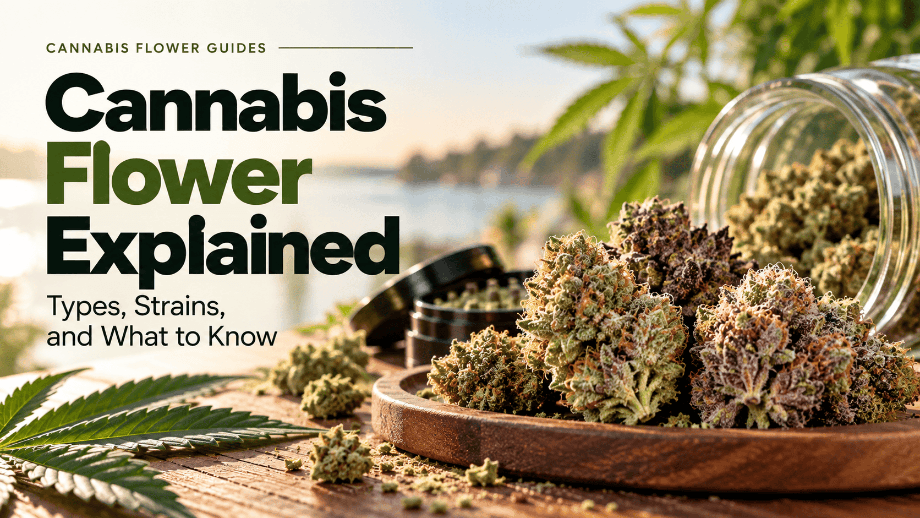
Cannabis flower is the flowering portion of the cannabis plant. It is also commonly called “bud.” After harvest, flower intended for a regulated cannabis market may go through drying, curing, testing, packaging, and other required processes before reaching its final packaged form.
The term “flower” describes the plant material rather than every cannabis product made from it. Concentrates, edibles, and other cannabis products belong to different product categories.
Pre-rolls may contain cannabis material, but they are also a distinct prepared product format. Learn more about cannabis pre-roll types and ingredients, including how standard and infused varieties differ.
Flower can also be described in several different ways. A label or product description may identify a cultivar or strain name, cannabinoid content, net weight, classification, testing information, and other details. Therefore, “cannabis flower” is only the starting point for understanding the information associated with a product.
In simple terms, cannabis flower is the harvested flowering portion of the cannabis plant, commonly called bud.
Cannabis Flower Terms at a Glance
Cannabis terminology comes from several areas, including botany, chemistry, regulation, and common industry language. As a result, two words on the same label may describe completely different characteristics. Knowing the basic vocabulary makes the rest of the information easier to understand.
| Term | Simple Meaning |
|---|---|
| Flower | The flowering portion of the cannabis plant |
| Bud | Common term for cannabis flower |
| Cultivar | A cultivated plant variety |
| Strain | Common cannabis-industry term for a named variety |
| Cannabinoid | A class of compounds associated with cannabis |
| THC | Tetrahydrocannabinol |
| THCA | Tetrahydrocannabinolic acid |
| CBD | Cannabidiol |
| CBDA | Cannabidiolic acid |
| Terpenes | Aromatic compounds found in cannabis and many other plants |
| Indica | Common cannabis classification term |
| Sativa | Common cannabis classification term |
| Hybrid | Common classification generally associated with mixed lineage |
| Net weight | Amount of product contained in the package |
| Testing information | Information associated with laboratory analysis |
These definitions provide a foundation rather than a complete explanation of each subject. Cannabinoids, classifications, and Michigan labeling requirements are large topics on their own. We will introduce each one below and explore them separately in this educational series.
What Parts of the Cannabis Plant Are Called Flower?
The cannabis plant contains stems, leaves, roots, and reproductive structures. When people refer to cannabis “flower,” they generally mean the flowering structures rather than the entire plant. These structures can contain several visible features that have their own terminology.
Buds are the clustered flowering structures commonly referred to as cannabis flower. Trichomes are small glandular structures found on cannabis surfaces. They are associated with the production and storage of various plant compounds. Pistils are parts of the flower's reproductive structure and can appear as small hair-like features.
Small leaves surrounding flower clusters are often called sugar leaves. However, these terms describe different botanical features and should not all be treated as synonyms for flower.
Understanding this distinction helps explain why cannabis terminology extends beyond simply calling everything “bud.”
This article focuses on terminology rather than cultivation. Growing methods, harvesting techniques, and processing practices involve separate subjects and regulations.
What Are the Different Types of Cannabis Flower?
The phrase “types of cannabis flower” can mean several different things. Some people use “type” to describe indica, sativa, or hybrid. Others may be referring to different cultivars, cannabinoid profiles, or product characteristics.
Cannabis flower can therefore be described according to several categories:
• Cultivar or strain name: Identifies a named cannabis variety in common industry terminology.
• Commercial classification: Terms such as indica, sativa, and hybrid may appear.
• Cannabinoid profile: Laboratory information can describe cannabinoids such as THC and CBD.
• Terpene information: Some product information may identify aromatic compounds called terpenes.
• Product and label information: Weight, testing information, dates, and other identifiers provide additional context.
These categories are not interchangeable. For example, “hybrid” is a classification term, while THC is a cannabinoid. Likewise, a cultivar name is not the same thing as a laboratory cannabinoid result.
- This distinction is important because cannabis cannot be completely described by one label or category. Several pieces of information may be needed to understand how a particular flower product is identified.
What Do Indica, Sativa, and Hybrid Mean?
Indica, sativa, and hybrid are among the most familiar cannabis classification terms. They are widely used in consumer-facing cannabis terminology. However, the history and science behind these categories are more complicated than the three labels may suggest.
Indica and sativa have historical and botanical roots. Meanwhile, “hybrid” is commonly used for cannabis with mixed lineage. Modern cannabis has also undergone extensive breeding and hybridization, which makes simple classification more difficult.
A large U.S. study (source) examined cannabinoid and terpene data from 89,923 commercial cannabis flower samples. Researchers found that commercial labels such as indica, hybrid, and sativa did not consistently map neatly onto the chemical patterns they analyzed.
That is one reason these labels should not automatically be treated as guarantees of a specific chemical profile.
What's the Difference Between a Cannabis Strain and Cultivar?
“Strain” is one of the most commonly used words in cannabis culture and commerce. It generally refers to a named cannabis variety. Consumers may therefore encounter many different strain names when reading cannabis-related information.
“Cultivar” is a plant-science term referring to a cultivated variety. For that reason, cultivar can be a more precise term when discussing intentionally selected plant varieties. However, both words appear in cannabis discussions, and “strain” remains widely recognized.
The important point is that a name alone does not describe everything about cannabis flower. Two products carrying similar names should not automatically be assumed to have identical chemical profiles.
Growing conditions, genetics, testing, and other factors can add more information. This is another reason flower should be understood through multiple pieces of information rather than a name alone.
What Are Cannabinoids in Cannabis Flower?
Cannabinoids are a class of chemical compounds associated with cannabis. Cannabis contains numerous cannabinoids and cannabinoid-related compounds. Product labels and laboratory reports may identify some of them by abbreviated names.
THC and CBD are two of the most widely recognized terms. However, consumers may also encounter THCA and CBDA. These abbreviations refer to related but distinct chemical compounds.
Understanding this distinction matters when reading flower information. Seeing several cannabinoid values on one label does not necessarily mean the label is repeating the same measurement. Each abbreviation can represent something different.
This pillar guide only introduces those terms. Their chemistry, relationships, percentages, and label presentation deserve a more detailed explanation.
What Do THC, THCA, CBD, and CBDA Mean?
Cannabis labels can contain abbreviations that look similar but refer to different compounds. Learning their full names provides a useful starting point. It also helps readers understand why several values might appear together.
THCA and THC are related, but they should not simply be treated as two names for the exact same thing. The same principle applies to CBDA and CBD. Chemical changes can occur under certain conditions, which is one reason cannabis chemistry requires more explanation than a single percentage.
Michigan's Cannabis Regulatory Agency also addresses THCA-related regulatory questions in its official advisory bulletins, providing additional context for how cannabinoid terminology is treated within the state's regulated market.
Michigan flower labels can also report cannabinoid information based on laboratory potency testing. Therefore, understanding these abbreviations becomes especially useful when interpreting regulated product information.
What Does THC Percentage Mean on Cannabis Flower?
THC percentage is commonly displayed as part of cannabis flower information. At a basic level, the percentage communicates measured cannabinoid content reported through laboratory analysis. However, that number should be interpreted in context rather than as a complete description of the flower.
One common misunderstanding is treating a larger THC number as an automatic quality score. THC percentage measures a particular chemical characteristic. It does not independently describe every botanical, chemical, testing, or product characteristic.
Laboratory measurements also exist within testing and reporting systems. Michigan's Cannabis Regulatory Agency oversees licensed safety-compliance facilities that perform testing on products in the state's regulated market.
Therefore, percentages appearing on regulated products are connected to laboratory analysis rather than simply being descriptive marketing terms.
A useful rule to remember is: THC percentage is a measurement, not a complete measure of cannabis flower quality.
What Are Terpenes in Cannabis Flower?
Terpenes are aromatic compounds produced by many plants, not only cannabis. They contribute to the characteristic aromas associated with plants, fruits, herbs, and other botanical materials. Cannabis can contain many different terpenes.
Names commonly encountered in cannabis discussions include myrcene, limonene, pinene, and caryophyllene. These are chemical names rather than cannabis varieties. Therefore, a terpene name and a strain name should not be treated as the same type of information.
Terpene discussions sometimes include broad claims about guaranteed experiences or health outcomes. However, this educational guide does not use terpene names to promise specific effects. Such claims require much more evidence and context than a simple product term provides.
A regulated cannabis flower label can contain several categories of information. Some identify the product, while others communicate laboratory results, package information, warnings, or regulatory details. This makes the label an important source of context.
Current Michigan CRA compliance guidance identifies information such as:
• The name and license number of the licensee that packaged the product.
• Harvest date, where applicable.
• Strain name, where applicable.
• Net weight.
• Laboratory-reported THC and CBD concentrations.
• Information identifying the laboratory that performed passing compliance testing.
• Test analysis date.
• Michigan's required universal symbol.
• Required warning information.
These fields do not all answer the same question. Net weight describes quantity, while cannabinoid concentrations report laboratory measurements. A harvest date provides different information from a test date.
This is why reading only the largest number on a label can leave out useful context. Our dedicated How to Read a Cannabis Product Label in Michigan [Interlink to Article 6] will explain these fields and Michigan-specific labeling requirements in detail.
Michigan regulates testing within its licensed cannabis market. The Cannabis Regulatory Agency's Scientific Section oversees safety-compliance facilities that perform safety and compliance testing on products sold through the state's licensed system.
Testing serves more than one informational purpose. Laboratory analysis can report cannabinoid potency, while compliance testing also addresses regulated safety requirements. Therefore, the word “tested” should not automatically be interpreted as referring only to THC percentage.
Michigan also uses Metrc as its statewide seed-to-sale tracking system. According to the CRA, serialized tags and package labels help track cannabis inventory through stages that can include growth, drying, curing, and eventual retail sale.
What Do Net Weight, Dates, and Package Information Mean?
Cannabis flower packaging contains information beyond cannabinoid percentages. These details can help identify what the package contains and connect it with regulated production and testing records. However, each field serves a different purpose.
Net weight tells the reader how much product the package contains. It may be expressed using customary or metric units. Weight is a quantity measurement and should not be confused with cannabinoid concentration.
Product weight and legal possession limits are different concepts. For local legal context, read our guide to cannabis laws in New Buffalo, Michigan, which covers possession restrictions and other rules for adults 21 and older.
Harvest information, where applicable, identifies when plant material was harvested. Test information relates to laboratory analysis. Because those dates refer to different events, they should not automatically be interpreted as interchangeable.
How Is Cannabis Flower Different From Other Cannabis Product Types?
Cannabis flower is only one cannabis product category. Other terms may describe products that contain cannabis material, extracts, or infused ingredients. Understanding the basic taxonomy prevents different product types from being confused.
Other cannabis formats have different characteristics and terminology. Our educational guides explain how cannabis vapes work and what cannabis edibles are, including their components, ingredients, and important differences from flower.
These definitions describe product formats rather than recommending one over another. Each category can also have its own terminology, testing considerations, and regulatory requirements.
5 Common Misunderstandings About Cannabis Flower
Cannabis terminology is often simplified in everyday conversations. However, simple labels can create assumptions that go beyond what the information actually shows. These five misunderstandings are particularly useful to recognize.
1. “Higher THC always means higher-quality flower.” THC percentage measures cannabinoid content. It is not a universal quality score and does not describe every characteristic of cannabis flower.
2. “Indica and sativa guarantee specific effects.” These commercial classifications do not perfectly represent chemical composition. Modern breeding and hybridization make the picture more complex.
3. “A strain name tells you everything about the flower.” A name identifies a variety in common terminology, but it does not replace laboratory or other product information.
4. “THC and THCA are exactly the same thing.” They are related compounds, but the terms are chemically distinct. Treating the abbreviations as interchangeable can make labels harder to understand.
5. “One percentage tells you everything important about flower.” Cannabis flower information can include cannabinoids, weight, cultivar, testing, dates, terpenes, and other details. One number cannot summarize all of those categories.
Why Indica, Sativa, and Strain Names Don't Tell the Whole Story
Modern cannabis classification is more complicated than many consumer-facing labels suggest. A major study of 89,923 commercial flower samples analyzed cannabinoids, terpenes, and common industry labels across six U.S. states.
The researchers found that commercial indica, hybrid, and sativa labels did not consistently correspond to the chemical groupings they identified.
The researchers also examined strain-name consistency across products from different cultivators. Their findings support a broader lesson: names and commercial categories can provide information, but they should not automatically be treated as complete chemical descriptions.
Other genomic research has also questioned overly simple cannabis classification systems. Modern hybridization and genetic diversity make cannabis taxonomy an active scientific subject rather than a perfectly settled three category system.
10 Cannabis Flower Terms Worth Knowing
A reader does not need to memorize every technical cannabis term. However, understanding a small set of common words makes flower labels and educational resources much easier to follow.
- Flower: The flowering portion of the cannabis plant.
- Bud: A common term used to describe cannabis flower.
- Cultivar: A cultivated plant variety.
- Strain: A widely used cannabis term for a named variety.
- Cannabinoid: A class of compounds associated with cannabis.
- THC: The abbreviation for tetrahydrocannabinol.
- THCA: The abbreviation for tetrahydrocannabinolic acid.
- CBD: The abbreviation for cannabidiol.
- Terpene: An aromatic compound found in cannabis and many other plants.
- Net weight: The quantity of product contained in a package.
These terms describe different aspects of cannabis flower. Some concern plant classification, others chemistry, and others packaging. Keeping those categories separate makes product information easier to interpret accurately.
Frequently Asked Questions About Cannabis Flower
What Does “Flower” Mean in Cannabis?
Cannabis flower refers to the flowering portion of the cannabis plant. The term “bud” is also commonly used for this plant material. Flower can later be identified by cultivar, cannabinoid information, weight, testing information, and other details. It should not be confused with every other cannabis product category.
Is Cannabis Flower the Same as Bud?
In common cannabis terminology, “bud” generally refers to cannabis flower. However, a cannabis plant contains many other structures, including stems, leaves, trichomes, and reproductive features. Therefore, “bud” is a common name for the flower rather than a name for the entire plant. Both terms are widely encountered in educational and commercial discussions.
What Is the Difference Between a Strain and a Cultivar?
“Strain” is widely used in cannabis culture and commerce to describe named varieties. “Cultivar” is a botanical and horticultural term for a cultivated variety. The terms may therefore appear in similar contexts, although cultivar can be more precise from a plant-science perspective. Neither term alone provides a complete chemical description of flower.
Does Higher THC Mean Better Cannabis Flower?
No. THC percentage measures a specific aspect of cannabinoid content and should not automatically be interpreted as an overall quality score. Flower can be described using many other characteristics and laboratory measurements.
What Information Can Appear on a Michigan Cannabis Flower Label?
Michigan CRA guidance identifies information that can include net weight, THC and CBD concentrations reported after potency testing, applicable harvest and strain information, laboratory details, testing dates, the universal symbol, and required warnings. These fields communicate different types of information rather than one overall product rating. Our Michigan cannabis product label guide [Interlink to Article 6] will explain how to interpret them in detail.
Continue Learning About Cannabis Flower
Cannabis flower is easier to understand when its terminology is separated into clear categories. Flower and bud describe plant material, while strain and cultivar describe varieties.
THC, THCA, CBD, and terpenes concern chemistry, while weight, testing information, dates, and warnings provide additional label context.
A single strain name, classification, or percentage does not describe everything about cannabis flower. Looking at terminology in context creates a more accurate understanding and avoids common assumptions.
