
What Are Cannabis Edibles? Types, Ingredients & How They Work

by Trapstars Team | October 11, 2026
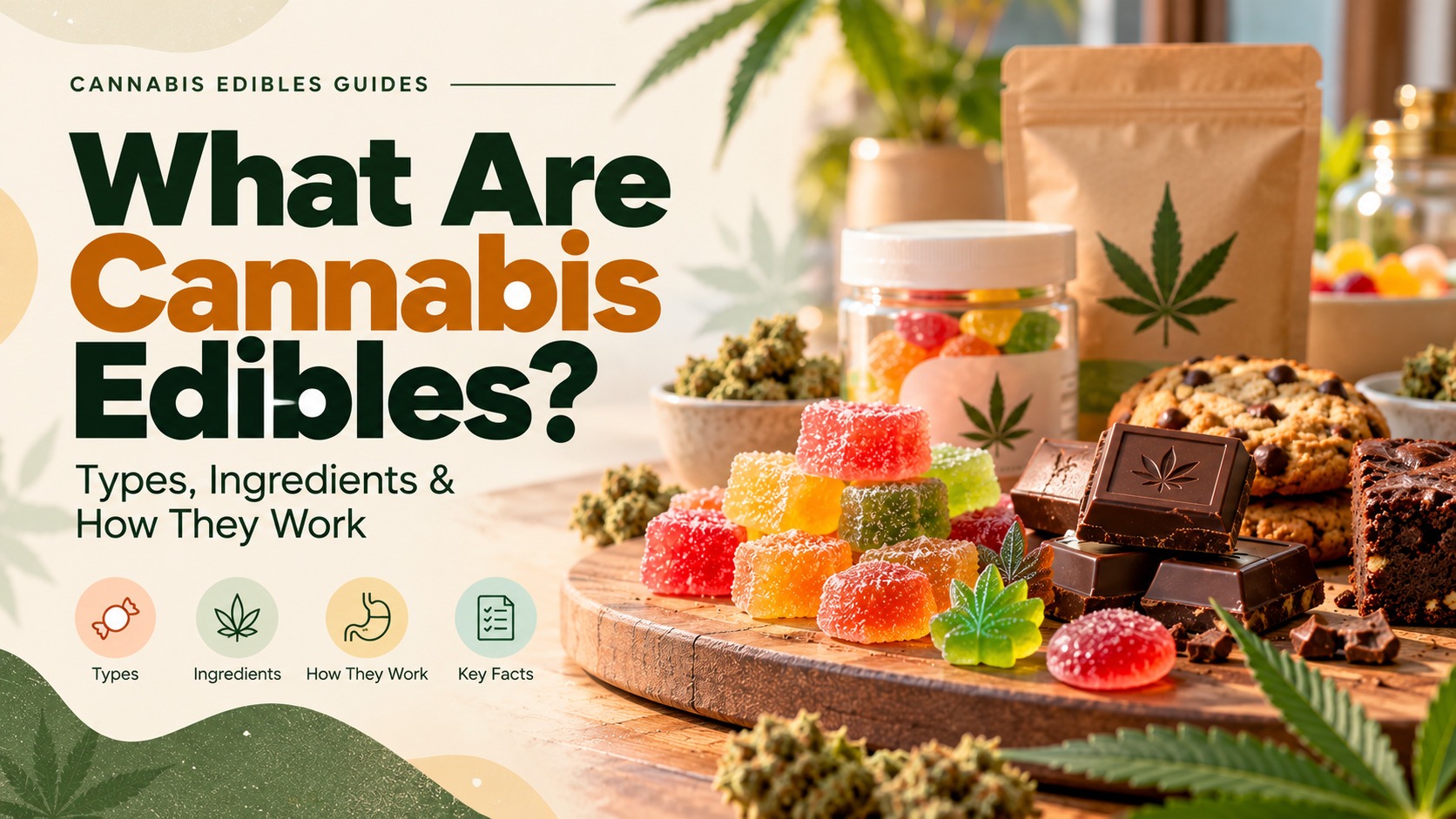
Cannabis edibles are foods and beverages containing cannabis-derived compounds such as THC or CBD. Common examples include gummies, chocolates, baked goods, and infused drinks.
Unlike smoked or vaporized cannabis, edibles enter the body through the digestive system, which changes how and when their effects may appear.
Their ingredients, cannabinoid content, and labeling also vary. This guide explains what cannabis edibles are, how they work, the main product types, and the safety and regulatory considerations relevant to Michigan.
What Are Cannabis Edibles?
Cannabis edibles are food or beverage products containing cannabis or cannabis-derived ingredients. Manufacturers may incorporate cannabis extracts, cannabinoids, or other cannabis preparations into conventional food formulations.
Consequently, the term “edible” describes how the product is consumed rather than one particular ingredient or cannabinoid concentration.
The Centers for Disease Control and Prevention (CDC) describes edibles as food and drink products infused with cannabis. They differ from inhaled products because the body processes their cannabinoids through the digestive system.
Some edibles contain THC, the principal intoxicating cannabinoid associated with cannabis. Others contain CBD or combinations of cannabinoids. Therefore, an edible's appearance does not establish whether it produces intoxicating effects.
Edibles also vary in their food ingredients, manufacturing methods, and packaging. A cannabis-infused chocolate and a cannabis-infused beverage may share certain cannabinoids but differ significantly in their formulation.
Understanding these distinctions provides a foundation for interpreting edible-product descriptions and labels.
What Types of Cannabis Edibles Are There?
Cannabis edibles appear in several food and beverage formats. Although these products share an ingestible form, their ingredients, physical characteristics, and regulatory classifications may differ.
The following categories describe common edible formats rather than recommended products.
Cannabis Gummies and Chews
Cannabis gummies are confectionery-style products containing cannabis-derived ingredients. They may be formulated with gelatin, pectin, sweeteners, flavorings, and cannabinoid preparations.
Different products can vary in shape, texture, and cannabinoid composition. Therefore, the word “gummy” describes the food format rather than a particular THC or CBD concentration.
In Michigan, edible product shapes and packaging are subject to restrictions intended to reduce their appeal to children. These requirements are particularly relevant to confectionery-style products.
Cannabis Chocolates
Cannabis chocolates incorporate cannabis-derived ingredients into chocolate-based formulations. Depending on the product, they may also contain milk, soy, nuts, or other ingredients relevant to food allergies.
The cannabinoid formulation is separate from the chocolate itself. Consequently, two products with similar appearances can contain different cannabinoids or quantities.
Chocolate products may be divided into individually marked pieces or packaged in other formats. However, the number of pieces should not be confused with the product's total cannabinoid content.
Cannabis-Infused Baked Goods
Cannabis-infused baked goods include products such as brownies, cookies, and other prepared foods. These products combine conventional baking ingredients with cannabis-derived compounds.
Their recipes may contain common allergens, including wheat, eggs, dairy, or nuts. As a result, ordinary food-label information remains important alongside cannabinoid labeling.
The physical size of a baked good does not establish its THC content. A product's cannabinoid information must be interpreted separately from its weight or appearance.
Cannabis-Infused Beverages
Cannabis-infused beverages contain cannabis-derived ingredients in a drinkable formulation. Examples may include flavored drinks and other prepared beverages.
Beverages differ from solid foods in their formulation, packaging, and stability requirements. Michigan's Cannabis Regulatory Agency (CRA) maintains a separate approval process for marijuana-infused beverages.
The agency requires regulated beverage formulations to address product safety and consistency. Therefore, cannabis beverages should not automatically be treated as identical to gummies or baked goods under Michigan's rules.
Other Cannabis-Infused Foods
Cannabis-derived ingredients may also appear in other food formats. However, product terminology can overlap with categories that regulators treat separately.
For example, capsules, tinctures, and certain oral drops may contain cannabinoids but are not necessarily classified as conventional edible foods. Michigan's CRA identifies medicinal products separately from infused edibles in its maximum-THC guidance.
This distinction matters because the method of administration and regulatory category are not always the same thing. Not every cannabis product taken by mouth is classified as an edible food.
What Ingredients Are Found in Cannabis Edibles?
Cannabis edibles typically combine cannabis-derived compounds with ordinary food or beverage ingredients. However, the complete formulation depends on the product.
Some products contain a cannabis extract blended into a food base. Others use different formulations intended to distribute cannabinoids throughout the finished product.
The following table explains common ingredient categories:
| Ingredient category | What it contributes |
|---|---|
| Cannabis extract | Source of cannabinoids in many infused products |
| THC | Intoxicating cannabinoid that may be present |
| CBD | Cannabinoid without THC's characteristic intoxicating effects |
| Other cannabinoids | Additional cannabis compounds, depending on formulation |
| Sweeteners | Flavor and food structure |
| Fats or oils | Food texture and formulation characteristics |
| Gelatin or pectin | Structure in some gummies and chews |
| Flavorings | Taste and aroma |
| Preservatives or stabilizers | Product stability, where used |
| Food allergens | Ingredients such as milk, soy, wheat, or nuts |
An edible's ingredient list and cannabinoid information answer different questions. For example, a label may identify both a chocolate ingredient containing milk and a specific amount of THC.
Therefore, understanding the product requires attention to both ordinary food composition and cannabis-related labeling.
How Do Cannabis Edibles Work in the Body?
Cannabis edibles enter the body through ingestion. After someone swallows an edible, the digestive system processes the food or beverage and its associated cannabinoids.
This process differs from inhalation, where compounds enter through the respiratory system. Consequently, edible cannabis has a different pattern of absorption and metabolism.
After ingestion, cannabinoids can be absorbed through the gastrointestinal tract. However, the timing and extent of absorption can vary.
The composition of the edible may influence this process. Other factors, including food already present in the digestive system and individual biological differences, can also affect how cannabinoids are absorbed.
As a result, two people may experience different responses to products with similar reported cannabinoid content. Even the same person may not experience identical effects on separate occasions.
This variability is one reason that edible products require a different scientific explanation from pre-rolls or vape devices.
The Role of the Liver
After absorption, cannabinoids can undergo metabolism in the liver. During this process, the body chemically transforms some of the compounds.
For example, delta-9 THC can be metabolized into 11-hydroxy-THC, a psychoactive metabolite. This metabolic pathway is one of the important distinctions between ingested THC and THC delivered through inhalation.
However, the amount of metabolite produced and its contribution to effects vary. The presence of this pathway does not allow a precise prediction of an individual's experience.
Therefore, edible cannabis should not be understood as simply a slower version of smoking. Digestion and metabolism introduce additional biological processes.
Why Do Cannabis Edibles Have Delayed Effects?
Cannabis edibles generally take longer to produce noticeable effects than inhaled cannabis. The difference arises partly because cannabinoids must pass through digestion and absorption before reaching systemic circulation.
According to the CDC, intoxicating effects from edible cannabis may take 30 minutes to two hours to become noticeable. However, this range is not a guarantee for every person or product.
The CDC also explains that effects may last longer than expected. Factors such as food intake, other substances, medications, and individual differences can influence the response.
Delayed effects create a particular safety concern because the absence of immediate effects does not establish that a product contains little or no THC. The CDC identifies this unpredictability as one reason edible cannabis can be associated with accidental overconsumption and poisoning.
Why Are Edible Effects Difficult to Predict?
Several variables influence the way the body processes ingested cannabinoids. These include the edible's formulation, the amount and type of cannabinoids, and differences between individuals.
Product-label accuracy is another consideration. The CDC notes that THC concentration in edible products can sometimes be unknown or inaccurately labeled, particularly outside reliably regulated settings.
Therefore, neither the physical size of an edible nor a person's previous experience can establish exactly when its effects will appear. This uncertainty is a scientific and safety consideration, not a reason to assume that one edible format has predictable effects for everyone.
What Is the Difference Between THC and CBD Edibles?
THC and CBD are cannabinoids found in cannabis. However, they have different pharmacological characteristics, and products containing them should not automatically be treated as equivalent.
THC is primarily associated with cannabis intoxication. CBD does not produce the same characteristic intoxicating effects, although CBD-containing products can still raise questions about composition, interactions, and labeling.
Some edibles contain THC as their main cannabinoid. Others contain CBD, while some contain a combination of cannabinoids.
The distinction matters because the term “cannabis edible” does not identify a universal cannabinoid profile.
CBD product labels should not automatically be interpreted as proof that a product contains no THC. Actual composition depends on the formulation and its testing information.
Similarly, cannabinoid labels should not be interpreted as medical claims. A product's reported chemical composition does not establish that it treats or prevents a health condition.
For a broader explanation of cannabinoid terminology, our guide to cannabis flower types, labels, and common terms covers THC, CBD, and other terms frequently used in cannabis product descriptions.
How Are Cannabis Edibles Different From Pre-Rolls and Vapes?
Cannabis edibles, pre-rolls, and vapes represent different cannabis product formats. Their main distinction concerns how cannabis compounds enter the body.
Edibles are ingested, while conventional pre-rolls and cannabis vapes are inhaled. This difference affects absorption, metabolism, and the timing of potential effects.
| Feature | edibles | pre-rolls | vapes |
|---|---|---|---|
| Product format | Food or beverage | cannabis joint | Electronic heating device |
| Route of exposure | Ingestion | Inhalation | Inhalation |
| Typical material | Cannabis-infused food ingredients | Cannabis plant material | Cannabis extract or plant material |
| Main process | Digestion and metabolism | Combustion | Electronic heating |
| Output | Ingested cannabinoids | Smoke | Aerosol |
| Distinct considerations | Delayed effects, food ingredients, accidental ingestion | Smoke exposure | Aerosol constituents and device risks |
These distinctions do not establish that one category is harmless. Each has its own safety considerations. For more information about inhalable formats, see What Are Cannabis Pre-Rolls? Types, Ingredients & How They Differ and What Is a Cannabis Vape and How Does It Work?
What Does a Cannabis Edible Label Tell You?
Cannabis edible labels can provide information about cannabinoids, serving quantities, ingredients, allergens, manufacturing, and testing. However, several measurements that appear together on a package describe different things. Understanding those distinctions is essential for interpreting the label accurately.
THC per serving describes the reported THC quantity associated with one labeled serving. Total THC per package describes the combined reported THC quantity in the entire package.
These figures are not necessarily identical because one package may contain multiple servings. For example, a hypothetical package with four labeled servings containing 5 milligrams of THC each would have 20 milligrams of total THC. This example illustrates label arithmetic only; it is not a suggested serving amount.
The key distinction is that a serving measurement and a package total represent different quantities. Neither should be confused with the physical weight of the food.
Understanding Common Edible Label Terms:
| Label term | Meaning |
|---|---|
| THC per serving | Reported THC associated with one labeled serving |
| Total THC | Reported THC in the full package |
| Serving count | Number of labeled servings |
| CBD content | Reported amount of CBD |
| Net weight | Physical quantity of the food product |
| Ingredient list | Food and cannabis-related ingredients |
| Allergen information | Declared relevant food allergens |
| Batch or lot number | Manufacturing or tracking identifier |
| Testing information | Laboratory or compliance-related details |
| Licensee information | Identification of the regulated business |
A product's net weight should not be confused with its cannabinoid quantity. A food item may weigh many grams while containing cannabinoids measured in milligrams.
Likewise, serving divisions do not necessarily describe how evenly cannabinoids are distributed. Michigan's regulatory framework includes requirements intended to address consistency in infused products.
Why Do Ingredients and Allergens Matter?
Cannabis edibles remain food products, even when they contain cannabinoids. Therefore, ordinary ingredient and allergen information remains relevant.
A cannabis-infused chocolate may contain milk or soy, while baked goods may contain wheat, eggs, or nuts. Other formulations may contain additional allergens.
Consequently, cannabinoid labeling cannot replace a complete food ingredient assessment. Readers need to distinguish the cannabis content from the rest of the product's composition.
How Does Michigan Regulate Cannabis Edibles?
Michigan's licensed cannabis market is regulated by the Cannabis Regulatory Agency. The CRA oversees requirements concerning marijuana-infused products, including edible formulation, testing, labeling, and packaging.
These requirements vary by product category. In particular, the CRA distinguishes infused edibles from cannabis-infused beverages and certain medicinal products.
Therefore, a single THC concentration rule should not automatically be applied to every ingestible cannabis product.
Michigan's Adult-Use THC Limits for Edibles
The CRA's April 24, 2025 technical bulletin establishes maximum THC concentrations for several marijuana-infused product categories. For adult-use products, the bulletin identifies the following limits:
The bulletin calculates the relevant THC maximum using the combined amounts of delta-8 and delta-9 THC. It also provides additional requirements concerning delta-8 THC concentration and formulation consistency.
For beverages, the CRA clarifies that the 100-milligram container limit does not automatically apply to an outer convenience package containing multiple separate beverage containers.
Medical product limits may differ from adult-use limits. Therefore, the category and regulatory context must be identified before interpreting a numerical maximum.
Why Are Cannabis Beverages Regulated Separately?
Cannabis-infused beverages introduce formulation concerns that differ from solid edible products. For example, regulators may need to evaluate ingredient stability and consistency throughout the product's shelf life.
Michigan's CRA maintains an approval process for new marijuana-infused beverage formulations and changes to existing formulations.
The agency explains that regulated beverages must be shelf-stable and produced to support safety and consistency. This distinction helps explain why beverages appear separately in the CRA's regulatory guidance.
Consequently, the term “edible” is useful for general education, but the precise regulatory category may be more specific.
Are Cannabis Edibles Tested in Michigan?
Cannabis edibles can resemble ordinary foods, including gummies, chocolates, and baked goods. This resemblance creates a particular risk when children encounter products without recognizing their cannabis content.
The CDC warns that accidental cannabis ingestion can cause serious illness in children. Young children may experience severe effects and sometimes require emergency medical treatment or hospitalization.
Because edible effects can be delayed, an exposure may not be immediately obvious. Consequently, accidental ingestion requires prompt attention rather than waiting for symptoms to become severe.
Michigan's Child-Resistant Packaging Requirements
Michigan's marijuana-infused edibles enforcement guidance explains requirements for opaque, child-resistant packaging and restrictions on edible products designed in ways that may appeal to children.
The state also restricts edible products and packaging that could be confused with conventional commercial foods. Its rules address designs resembling recognizable candy products and certain shapes associated with children.
These restrictions are intended to reduce confusion and accidental exposure. However, child-resistant packaging does not mean that a product is childproof. Secure storage remains important, particularly in homes where children or pets may encounter food products.
What Should Someone Do After Accidental Ingestion?
If a child may have swallowed a cannabis edible, prompt guidance from a medical professional or poison control center is important. Serious symptoms require emergency medical attention. In the United States, Poison Control can be reached at 1-800-222-1222. For a medical emergency, call 911.
The CDC also advises keeping cannabis products away from children. Products should remain clearly identified and securely stored rather than being transferred into ordinary food containers.
Cannabis Edibles and Impaired Driving
Cannabis edibles can cause impairment, and their delayed effects create an important distinction from inhaled cannabis products. A person may not immediately notice intoxicating effects after ingestion. However, delayed onset does not eliminate the possibility of later impairment.
Michigan prohibits driving while under the influence of cannabis. The state's driving laws also include provisions concerning controlled substances in a driver's body.
These restrictions apply regardless of whether cannabis was ingested as an edible or delivered through another product format.
Frequently Asked Questions About Cannabis Edibles
Are Cannabis Gummies Considered Edibles?
Yes. Cannabis gummies are a type of edible because they are food products containing cannabis-derived ingredients. However, gummies are only one edible format. Other examples include chocolates, baked goods, and infused beverages. Their ingredients and cannabinoid concentrations can differ.
Do All Cannabis Edibles Contain THC?
No. Cannabis edibles may contain THC, CBD, or combinations of cannabinoids. THC is associated with cannabis intoxication, while CBD does not produce the same characteristic intoxicating effects. However, a CBD-labeled product should not automatically be assumed to contain no THC. The actual formulation and testing information matter.
Why Do Cannabis Edibles Take Longer to Produce Effects?
Edibles pass through digestion and absorption before cannabinoids enter circulation. THC can also undergo metabolism in the liver. According to the CDC, intoxicating effects may take 30 minutes to two hours to appear, although timing varies. Therefore, the absence of immediate effects does not establish that an edible contains no THC.
Can Cannabis Edibles Contain Food Allergens?
Yes. Cannabis edibles can contain the same allergens found in conventional foods. Chocolates may contain milk or soy, while baked goods may contain wheat, eggs, or nuts. Other formulations may have different ingredients. Therefore, cannabinoid information should be considered separately from food ingredient and allergen labeling.
Official Sources and Further Reading
The following sources provide scientific and regulatory information relevant to cannabis edibles:
These sources address different aspects of edible cannabis. CDC publications explain public-health concerns, while CRA materials establish Michigan-specific regulatory requirements.
Because regulations and scientific understanding can change, readers should consult current official sources for updated information.
Understanding Cannabis Edibles
Cannabis edibles are food and beverage products containing cannabis-derived compounds. Although they share an ingestible format, their ingredients, cannabinoid profiles, and regulatory classifications can vary considerably.
The most important scientific distinction involves digestion and metabolism. Unlike inhaled cannabis, edibles pass through the digestive system, which can delay noticeable effects and introduce additional variability.
Understanding product labels also requires separating serving quantities, total cannabinoid content, food ingredients, and allergens. Michigan's regulations further distinguish infused foods from beverages and establish specific requirements for testing and packaging.
These differences explain why cannabis edibles deserve their own educational category rather than being treated as another variation of smoked or vaporized cannabis.
